
Volume residential is a planning problem.
Townhome and subdivision work is won on organisation, not hours. We built our operation around that — so a mid-sized contractor can hold its own on cost and still supervise properly.
Small enough to care
You deal with the people actually running your project. Decisions don’t queue behind layers of account management, and the person who priced the job is the person who knows it.
Big enough to deliver
Our systems and supervision are built for repeatable, multi-unit work. Scale doesn’t break the process, and adding units doesn’t mean starting the planning over.
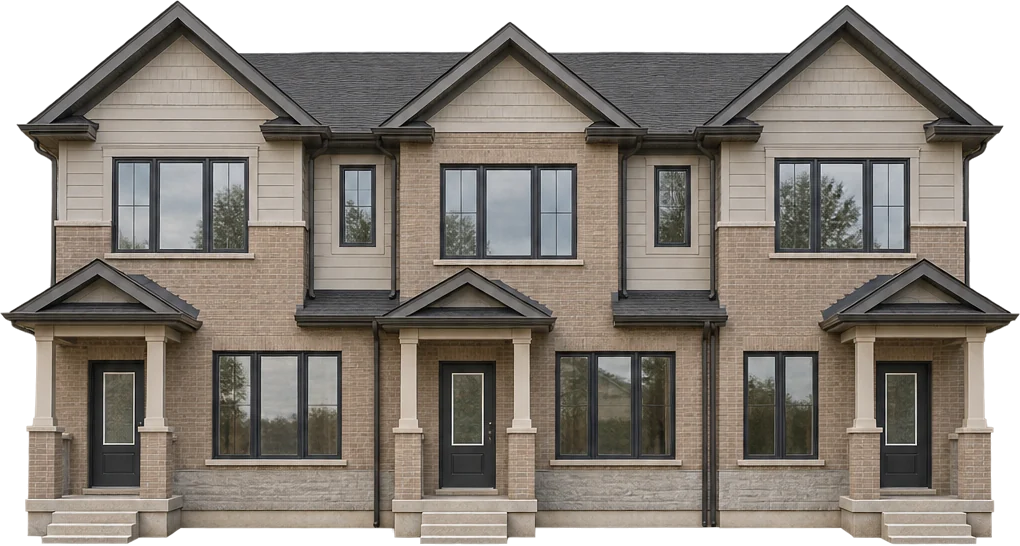
Townhomes, stacked towns and low-rise blocks.
Multi-unit residential is its own discipline. The units repeat, but the site does not — servicing, meter banks, common areas and staged occupancy all sit outside the unit template and all need planning around.
We price the standard unit properly, then plan the site work and the phasing around how the blocks will actually be released.
How we run community projects.
Three things let us compete on price with much larger operations without cutting the supervision that keeps quality consistent across units.
Optimized systems
We developed a repeatable system for multi-unit residential — standard layouts, standard material staging, standard sequencing — so each unit runs the same way rather than being solved from scratch.
Planning before wiring
Long before wire goes between studs, we build the internal operation plan using current project management tools. Crews arrive to a defined sequence rather than working it out on site.
Layered supervision
Supervision sits at more than one level, so quality is checked as the work progresses rather than discovered at inspection. That is what keeps delivery dates realistic.
What we take on across a development.
Building a community project?
Send us the drawings and unit count and we’ll review the electrical scope and come back to you with pricing.